by Steve Lubetkin, Globest.com
Estes Express Lines has signed a 77,987-square-foot lease at 400 Capital Lane in Middletown, PA. The 242,824-square-foot building, owned by a joint venture of Woodmont Industrial Partners and AEW Capital Management, is now fully leased.
400 Capital Lane is part of the recently-renovated Capital Logistics Center — a six-building, class A, 1.55-million-square-foot industrial complex that is situated on more than 100 acres. Building features include 30 dock doors, three drive-in doors, T5 lighting, a six-inch reinforced concrete floor and a standing seam metal roof.
In addition to 400 Capital Lane, the venture also recently completed capital improvements at 200 Capital Lane, the largest building in the complex. Currently, 400,060 square feet of space is available at 200 Capital Lane, which is equipped with T-5 lighting, an ESFR system, 87 dock doors plus two drive-in doors and 36-foot clear ceilings throughout. Earlier this year, this building was awarded LEED Silver building certification for its efficient use of resources and its commitment to sustainability. The building has also been outfitted with 3,000 square feet of move-in ready office space.
As a leading freight service provider, Estes was looking for high-quality space that offered a sufficient number of docks.
“The ideal location of the Capital Logistics Center and the modernization of 400 Capital Lane were key factors in attracting Estes to the property,” says Eric Witmondt, chief executive officer of Woodmont Industrial Partners. “We look forward to a long-term relationship with the company.”
Located in Central Pennsylvania at the heart of the I-81 Distribution Corridor, the Capital Logistics Center fronts the Pennsylvania Turnpike and is less than a mile away from Harrisburg International Airport. The property is also near local FedEx and UPS facilities as well as Routes I-283, I-83 and 322.
www.omegare.com
Tuesday, March 8, 2016


U.S. Commercial Property Prices Drop for First Time in Six Years
by Kara Wetzel, Bloomberg TV
Values fell 0.3% in January from prior month, Moody's says
Decline is `significant milestone' showing shift in sentiment
U.S. commercial real estate prices dropped in January for the first time since 2010, a sign of weakening demand by investors after a six-year rally that pushed values to records.
The Moody/RCA Commercial Property Price Index slipped 0.3 percent from December, Moody’s Investors Service said in a statement Monday. The decline was led by office and industrial buildings, which each had a price drop of more than 1 percent.
“This is a significant milestone that signals that a shift in sentiment among commercial-property investors is under way,” Moody’s said in the statement.
Volatility in financial markets may be hurting real estate demand. Rates of return are falling and it’s “very difficult” to bundle and sell real estate loans, hindering debt financing for transactions, Jon Gray, head of real estate for Blackstone Group LP, said at a conference last week. His company is the largest private equity property investor, with about $94 billion under management in real estate.
The Moody’s index has almost doubled since its January 2010 trough and is about 17 percent higher than its previous peak, as low interest rates and rebounding economic growth fueled property demand. Prices have jumped the most for office buildings in top cities such as New York and San Francisco, more than tripling since the market’s bottom.
www.omegare.com
Values fell 0.3% in January from prior month, Moody's says
Decline is `significant milestone' showing shift in sentiment
U.S. commercial real estate prices dropped in January for the first time since 2010, a sign of weakening demand by investors after a six-year rally that pushed values to records.
The Moody/RCA Commercial Property Price Index slipped 0.3 percent from December, Moody’s Investors Service said in a statement Monday. The decline was led by office and industrial buildings, which each had a price drop of more than 1 percent.
“This is a significant milestone that signals that a shift in sentiment among commercial-property investors is under way,” Moody’s said in the statement.
Volatility in financial markets may be hurting real estate demand. Rates of return are falling and it’s “very difficult” to bundle and sell real estate loans, hindering debt financing for transactions, Jon Gray, head of real estate for Blackstone Group LP, said at a conference last week. His company is the largest private equity property investor, with about $94 billion under management in real estate.
The Moody’s index has almost doubled since its January 2010 trough and is about 17 percent higher than its previous peak, as low interest rates and rebounding economic growth fueled property demand. Prices have jumped the most for office buildings in top cities such as New York and San Francisco, more than tripling since the market’s bottom.
www.omegare.com
Sunday, March 6, 2016
Gateway Funding Renews Lease in Horsham
Full-service mortgage banking firm Gateway Funding Diversified Mortgage Services has renewed its lease for 33,205 square feet at 300 Welsh Rd. in Horsham, PA.
The tenant will continue to occupy the entirety of Bldg 5 in the Horsham / Willow Grove submarket of Philadelphia through 2023.
The tenant will continue to occupy the entirety of Bldg 5 in the Horsham / Willow Grove submarket of Philadelphia through 2023.
Arzan Pays $123M for Exton Whitelands Campus
90 North Real Estate Partners LLP, the London-based real estate unit of Arzan Financial Group in Kuwait, acquired the Saint-GoBain North American headquarters campus at 20 Moores Rd. in Malvern, PA from AEGON USA Realty Advisors LLC and J. Loew & Associates / E. Kahn Development for $123 million, or about $383 per square foot.
The office complex delivered in 2014 in the Exton/Whitelands submarket of Philadelphia. It totals 321,226 square feet and is occupied by the Saint-Gobain Corporation.
www.omegare.com
The office complex delivered in 2014 in the Exton/Whitelands submarket of Philadelphia. It totals 321,226 square feet and is occupied by the Saint-Gobain Corporation.
www.omegare.com
Thursday, March 3, 2016
Drexel University Partnering With Brandywine On Schuylkill Yards Development
by Steve Lubetkin, Globest.com
Drexel University and Brandywine Realty Trust will partner on the multibillion-dollar, decades-long redevelopment of Philadelphia’s Schuylkill Yards project, a 14-acre master planned community.
Initial phases of the projected 20-year development plan will consist of 5 million gross square feet of mixed-use real estate on a 10-acre site next to Drexel’s main campus and adjacent to Amtrak’s 30th Street Station and Brandywine’s Cira Centre. This collaborative neighborhood will feature entrepreneurial spaces, educational facilities and research laboratories, corporate offices, residential and retail spaces, hospitality and cultural venues and public open spaces.
“Drexel has always believed there’s a superior use for this unique location — essentially the 50 yard line of the Eastern Seaboard — as a neighborhood built around collaboration and innovation. That’s why the University assembled these parcels, and the time is right to put this vision into action,” says Drexel president John A. Fry. “We’re looking forward to a generation of partnership with Brandywine Realty Trust. We selected them as master developer because of their nationally recognized expertise and financial capacity, and also their deep understanding of the project’s potential impact on Philadelphia. Schuylkill Yards is more than a large-scale development project; it will be the heart of America’s next great urban innovation district.”
The partners characterized the project as a long-term investment in Philadelphia and its University City neighborhood, with master developer Brandywine leading the development plan.

Schuylkill Yards will be an integrated urban environment, offering a collaborative and connected community made up of educational and medical institutions, businesses, residents and visitors bound together by the pursuit of innovation. Situated adjacent to Amtrak’s 30th Street Station, the third-busiest passenger rail station in the country, Schuylkill Yards will be connected to Philadelphia’s international airport and the major cities along the Northeast corridor, making it a major innovation hub on the East Coast. Schuylkill Yards will also create a new gateway to Drexel University and University City, a thriving submarket with one of the highest concentrations of higher education and medical institutions in the nation, including the University of Pennsylvania and its hospitals, University of the Sciences, The Children’s Hospital of Philadelphia, University City Science Center and the Wistar Institute.
Drexel University conducted a national search advised by Jones Lang LaSalle, which resulted in the selection of Brandywine Realty Trust, based in Philadelphia, as the master developer for the site. Brandywine is one of the largest publicly traded, full-service, integrated real estate companies in the United States, with a core focus in the Philadelphia, Washington, D.C., and Austin markets.
“Drexel University and Brandywine’s shared vision for the continued renaissance of University City provides a strong foundation for a long-term partnership. Together, we will create a dynamic and world-class innovation hub to attract the brightest minds to our region,” says Gerard H. Sweeney, president and CEO of Brandywine. “Schuylkill Yards will undeniably transform Philadelphia’s skyline as new towers rise on the west side of the Schuylkill River. Brandywine’s existing Cira Centre, EVO and FMC Tower at Cira Centre South projects in University City will provide a synergistic connection to Schuylkill Yards, creating a seamless access point to Center City and strengthening the eastern edge of University City as a whole.”
As master developer, Brandywine will oversee an experienced development team that includes Gotham Organization, Inc. leading the residential development, and Longfellow Real Estate Partners leading the life sciences component. Schuylkill Yards will be the first project in Philadelphia for both firms. Brandywine and Drexel University jointly selected the design team consisting of SHoP Architects and West 8. SHoP Architects will handle the district planning and development of the architectural standards, and West 8 will be responsible for creating the public realm and development of the landscape standards.
The development of Schuylkill Yards will take place in multiple phases over the course of approximately 20 years. When completed, the site is expected to host a combination of repurposed existing buildings and new tower structures with world-class design and programming and a diverse network of public spaces to incorporate the natural world in the urban environment. Schuylkill Yards’ development will begin with the creation of Drexel Square, a 1.3 acre park at 30th and Market Streets, directly across from Amtrak’s 30th Street Station. The historic former Philadelphia Bulletin Building will also be reimagined by transforming the east facade with inside/out viewports and a dynamic front screen.
Schuylkill Yards reflects the partners’ commitment to driving inclusive economic growth in the City of Philadelphia. The project will create thousands of jobs and generate tens of millions of dollars in tax revenue. Schuylkill Yards will incorporate specific pathways for residents of adjacent neighborhoods to share in the employment and business development opportunities, benefit from neighborhood revitalization, and access services offered by the partners and community of Schuylkill Yards. Additionally, Schuylkill Yards is designated as part of a Keystone Opportunity Zone, providing future businesses and residents with tax benefits that will further stimulate economic growth.
“Schuylkill Yards is a big step forward in University City’s transition to a next-generation business district. It will provide our region’s current and future innovators with a central hub for collaboration and signal to the world that Philadelphia is ready for business in the 21st century’s new economy,” says Philadelphia Mayor Jim Kenney. “Drexel University and Brandywine are creating one of the most valuable assemblages of real estate in the nation, and all of Philadelphia’s residents, institutions, businesses and visitors will share in the prosperity generated by this new center of innovation.”
“Schuylkill Yards will bring new, innovative businesses and residents to Pennsylvania, and the potential economic impact is tremendous,” Pennsylvania Governor Tom Wolf says. “Those who choose to make Schuylkill Yards their home will have access to many of the most innovative companies, organizations and educational institutions in our state.”
www.omegare.com
Drexel University and Brandywine Realty Trust will partner on the multibillion-dollar, decades-long redevelopment of Philadelphia’s Schuylkill Yards project, a 14-acre master planned community.
Initial phases of the projected 20-year development plan will consist of 5 million gross square feet of mixed-use real estate on a 10-acre site next to Drexel’s main campus and adjacent to Amtrak’s 30th Street Station and Brandywine’s Cira Centre. This collaborative neighborhood will feature entrepreneurial spaces, educational facilities and research laboratories, corporate offices, residential and retail spaces, hospitality and cultural venues and public open spaces.
“Drexel has always believed there’s a superior use for this unique location — essentially the 50 yard line of the Eastern Seaboard — as a neighborhood built around collaboration and innovation. That’s why the University assembled these parcels, and the time is right to put this vision into action,” says Drexel president John A. Fry. “We’re looking forward to a generation of partnership with Brandywine Realty Trust. We selected them as master developer because of their nationally recognized expertise and financial capacity, and also their deep understanding of the project’s potential impact on Philadelphia. Schuylkill Yards is more than a large-scale development project; it will be the heart of America’s next great urban innovation district.”
The partners characterized the project as a long-term investment in Philadelphia and its University City neighborhood, with master developer Brandywine leading the development plan.
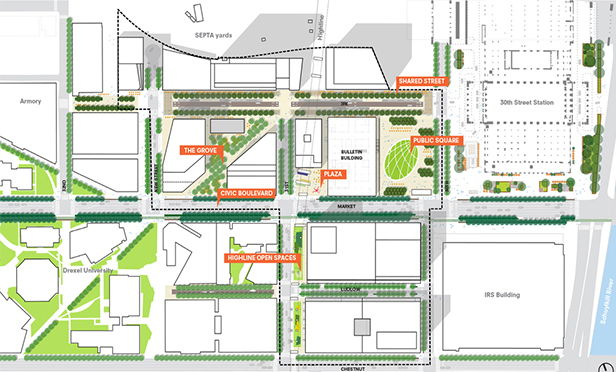
Schuylkill Yards will be an integrated urban environment, offering a collaborative and connected community made up of educational and medical institutions, businesses, residents and visitors bound together by the pursuit of innovation. Situated adjacent to Amtrak’s 30th Street Station, the third-busiest passenger rail station in the country, Schuylkill Yards will be connected to Philadelphia’s international airport and the major cities along the Northeast corridor, making it a major innovation hub on the East Coast. Schuylkill Yards will also create a new gateway to Drexel University and University City, a thriving submarket with one of the highest concentrations of higher education and medical institutions in the nation, including the University of Pennsylvania and its hospitals, University of the Sciences, The Children’s Hospital of Philadelphia, University City Science Center and the Wistar Institute.
Drexel University conducted a national search advised by Jones Lang LaSalle, which resulted in the selection of Brandywine Realty Trust, based in Philadelphia, as the master developer for the site. Brandywine is one of the largest publicly traded, full-service, integrated real estate companies in the United States, with a core focus in the Philadelphia, Washington, D.C., and Austin markets.
“Drexel University and Brandywine’s shared vision for the continued renaissance of University City provides a strong foundation for a long-term partnership. Together, we will create a dynamic and world-class innovation hub to attract the brightest minds to our region,” says Gerard H. Sweeney, president and CEO of Brandywine. “Schuylkill Yards will undeniably transform Philadelphia’s skyline as new towers rise on the west side of the Schuylkill River. Brandywine’s existing Cira Centre, EVO and FMC Tower at Cira Centre South projects in University City will provide a synergistic connection to Schuylkill Yards, creating a seamless access point to Center City and strengthening the eastern edge of University City as a whole.”
As master developer, Brandywine will oversee an experienced development team that includes Gotham Organization, Inc. leading the residential development, and Longfellow Real Estate Partners leading the life sciences component. Schuylkill Yards will be the first project in Philadelphia for both firms. Brandywine and Drexel University jointly selected the design team consisting of SHoP Architects and West 8. SHoP Architects will handle the district planning and development of the architectural standards, and West 8 will be responsible for creating the public realm and development of the landscape standards.
The development of Schuylkill Yards will take place in multiple phases over the course of approximately 20 years. When completed, the site is expected to host a combination of repurposed existing buildings and new tower structures with world-class design and programming and a diverse network of public spaces to incorporate the natural world in the urban environment. Schuylkill Yards’ development will begin with the creation of Drexel Square, a 1.3 acre park at 30th and Market Streets, directly across from Amtrak’s 30th Street Station. The historic former Philadelphia Bulletin Building will also be reimagined by transforming the east facade with inside/out viewports and a dynamic front screen.
Schuylkill Yards reflects the partners’ commitment to driving inclusive economic growth in the City of Philadelphia. The project will create thousands of jobs and generate tens of millions of dollars in tax revenue. Schuylkill Yards will incorporate specific pathways for residents of adjacent neighborhoods to share in the employment and business development opportunities, benefit from neighborhood revitalization, and access services offered by the partners and community of Schuylkill Yards. Additionally, Schuylkill Yards is designated as part of a Keystone Opportunity Zone, providing future businesses and residents with tax benefits that will further stimulate economic growth.
“Schuylkill Yards is a big step forward in University City’s transition to a next-generation business district. It will provide our region’s current and future innovators with a central hub for collaboration and signal to the world that Philadelphia is ready for business in the 21st century’s new economy,” says Philadelphia Mayor Jim Kenney. “Drexel University and Brandywine are creating one of the most valuable assemblages of real estate in the nation, and all of Philadelphia’s residents, institutions, businesses and visitors will share in the prosperity generated by this new center of innovation.”
“Schuylkill Yards will bring new, innovative businesses and residents to Pennsylvania, and the potential economic impact is tremendous,” Pennsylvania Governor Tom Wolf says. “Those who choose to make Schuylkill Yards their home will have access to many of the most innovative companies, organizations and educational institutions in our state.”
www.omegare.com
Wednesday, March 2, 2016
CityView Commercial Closes on Palmer Park Mall
Pennsylvania Real Estate Investment Trust (PREIT) has sold the Palmer Park Mall at 123-141 Palmer Park Mall at the corner of Park Ave. in Easton, PA to CityView Commercial for $18 million, or about $39 per square foot.
Palmer Park Mall was constructed in 1972 and renovated in 1998. It sits on 50 acres in the Lehigh / Northampton submarket. It is anchored by Boscov's and The Bon-Ton, which occupy 314,000 square feet combined.
Palmer Park Mall was constructed in 1972 and renovated in 1998. It sits on 50 acres in the Lehigh / Northampton submarket. It is anchored by Boscov's and The Bon-Ton, which occupy 314,000 square feet combined.
Understanding Suburban Markets Key, Say ULI Philadelphia Panelists
by Steve Lubetkin, Globest.com
Understanding suburban residents is critical to producing reimagined and redeveloped communities outside the urban core, say panelists at the Urban Land Institute Philadelphia District’s “Contagious Urbanization: How the Suburbs are Embracing Mixed-Use and Density,” held today at the Union League Club.
Eli Kahn, principal of E. Kahn Development Corp., presented redevelopment plans for downtown West Chester and Devon. As someone who grew up nearby, Eli explained how he aims to create an “urban light” environment, by building walkable and transit-oriented developments that are desirable to those used to a bustling city atmosphere. As previously reported by GlobeSt.com, Kahn successfully redeveloped a former insurance company headquarters in Malvern, PA, which was leased by building products company Saint-Gobain. Last week Kahn sold the property to Chicago developer 90 North.
Devon Yards, his latest project located in the former Waterloo Gardens property, includes the underground parking, an innovative commercial real estate choice, as well as trendy retail described as an “Urban Outfitters themed complex.”
Understanding what makes suburban real estate attractive to its target audience is essential to success, say the panelists.
James Mazzarelli, senior vice president at Liberty Property Trust, pointed out that the Great Valley Corporate Center is being rebuilt with the new decision makers – Gen X, Gen Y and other “digital natives” – in mind. By building active and collaborative work environments that fit into the increasingly common live/work/play lifestyle, Liberty Property Trust hopes properties like his can help set the bar for placemaking in suburban office spaces, he says.
Millennials and empty-nesters tend to have active lifestyles, so when redeveloping the Granite Run Mall, Michael Markman, president of BET Investments, says he knew they would have to incorporate public greenspaces. Markman says the roadmap for this project included speaking with key stakeholders and educating community members on their plans for what he called a “multipurpose desire destination” throughout the process. By building around a walkable courtyard that connects to the adjacent trail system, the new Granite Run Mall encourages patrons to live sustainably while still enjoying their leisure time.
Providing the community and government perspective, Terry Woodman, principal and special consulting projects and manager of East Whiteland Township (Chester County), gave insight as to how municipalities work with developers towards a common goal.
Suburbs are now ready to “put density where the infrastructure is,” she says, which is partly why so many mixed-use projects are in the works. As a veteran of the industry, Woodman stressed the importance of including the entire community in an open dialogue every step of the way. Developers, she says, should “work collaboratively with the township to build real estate, we can all ensure community value with a project.”
Panelists also fielded questions on the importance of public transit access, building for Millennials, young professionals and empty nesters, as well as addressing the “adult Disneyland” and other stigmas surrounding new mixed-use developments.
www.omegare.com
Understanding suburban residents is critical to producing reimagined and redeveloped communities outside the urban core, say panelists at the Urban Land Institute Philadelphia District’s “Contagious Urbanization: How the Suburbs are Embracing Mixed-Use and Density,” held today at the Union League Club.
Eli Kahn, principal of E. Kahn Development Corp., presented redevelopment plans for downtown West Chester and Devon. As someone who grew up nearby, Eli explained how he aims to create an “urban light” environment, by building walkable and transit-oriented developments that are desirable to those used to a bustling city atmosphere. As previously reported by GlobeSt.com, Kahn successfully redeveloped a former insurance company headquarters in Malvern, PA, which was leased by building products company Saint-Gobain. Last week Kahn sold the property to Chicago developer 90 North.
Devon Yards, his latest project located in the former Waterloo Gardens property, includes the underground parking, an innovative commercial real estate choice, as well as trendy retail described as an “Urban Outfitters themed complex.”
Understanding what makes suburban real estate attractive to its target audience is essential to success, say the panelists.
James Mazzarelli, senior vice president at Liberty Property Trust, pointed out that the Great Valley Corporate Center is being rebuilt with the new decision makers – Gen X, Gen Y and other “digital natives” – in mind. By building active and collaborative work environments that fit into the increasingly common live/work/play lifestyle, Liberty Property Trust hopes properties like his can help set the bar for placemaking in suburban office spaces, he says.
Millennials and empty-nesters tend to have active lifestyles, so when redeveloping the Granite Run Mall, Michael Markman, president of BET Investments, says he knew they would have to incorporate public greenspaces. Markman says the roadmap for this project included speaking with key stakeholders and educating community members on their plans for what he called a “multipurpose desire destination” throughout the process. By building around a walkable courtyard that connects to the adjacent trail system, the new Granite Run Mall encourages patrons to live sustainably while still enjoying their leisure time.
Providing the community and government perspective, Terry Woodman, principal and special consulting projects and manager of East Whiteland Township (Chester County), gave insight as to how municipalities work with developers towards a common goal.
Suburbs are now ready to “put density where the infrastructure is,” she says, which is partly why so many mixed-use projects are in the works. As a veteran of the industry, Woodman stressed the importance of including the entire community in an open dialogue every step of the way. Developers, she says, should “work collaboratively with the township to build real estate, we can all ensure community value with a project.”
Panelists also fielded questions on the importance of public transit access, building for Millennials, young professionals and empty nesters, as well as addressing the “adult Disneyland” and other stigmas surrounding new mixed-use developments.
www.omegare.com
Subscribe to:
Posts (Atom)
