Tuesday, October 24, 2023

$270B in CRE capital is on the sidelines. How much of that sum could go into distressed real estate?

 By Ashley Fahey – Editor, The National Observer: Real Estate Edition, The Business Journals

It's still mostly a waiting game for commercial loans and properties showing signs of distress — so what'll it take for more of those deals to trade?

At the end of the third quarter, an estimated $270.6 billion targeting North American real estate was sitting on the sidelines, according to Preqin Ltd. Of that, more than $100 billion was opportunistic capital, which typically targets properties requiring an aggressive repositioning and lease-up strategy, and also includes new development.

It comes at a time when the broader commercial real estate industry is watching what'll happen to an estimated $1.9 trillion in commercial real estate loans set to mature in the next four years. In particular, the office market is being closely observed as companies depart big blocks of space in older buildings in favor of consolidating into smaller offices in higher-quality buildings.

In September, the overall commercial-mortgage backed securities delinquency rate was 4.39%, an increase from 4.25% the month prior, according to Trepp LLC. The office delinquency rate also continued a monthly ascent (it has grown every month since December 2022), hitting 5.58% in September.

What will it take for distressed properties to trade?

While more distress is expected, it hasn't fully emerged yet, as lenders work with borrowers on short-term extensions and modify and restructure loans when possible.

The $100 billion or so earmarked for opportunistic real estate appears to be waiting to capitalize on emerging distressed situations across asset classes, said Aaron Jodka, director of U.S. capital markets research at Colliers International Inc. (Nasdaq: CIGI).

"We have to wait for some of these properties' debt to mature and a decision to be made," Jodka said. "A lot of investors are waiting for their hands to be forced: If they can wait out their existing financing, they’re going to do that. At the point that they need to refinance or they have an occupancy loss that doesn’t allow them to cover their debt service, that’s when those events will take place."

Pricing also has been cited as a major barrier for distressed and non-distressed buildings alike to trade. Commercial real estate investment volume was down by 60% year-over-year in the second quarter, according to CBRE Group Inc. (NYSE: CBRE).

Aaron Jackson, the loan enforcement team leader of law firm Polsinelli PC's financial services litigation practice group, said there are buyers in the market with the ability now to purchase buildings, even ones facing financial issues, low vacancy and that need a significant capital infusion.

But, he added, a lot of buyers don't feel prices have bottomed out. There also are a lot of commercial real estate loans that, by today's standards, have low interest rates, meaning more buyers are interested in assuming existing debt.

Jodka said there's evidence of bridge capital being deployed, even for things like construction loans that will come due during the time of development, to help offset the rapid rise of interest rates since they were underwritten.

Still, there's been an increase in fund redemption requests this year, particularly in the private REIT space, said Chad Littell, national director of capital market analytics at CoStar Group Inc. (Nasdaq: CSGP). It's also taking twice as long to raise money in a commercial real estate fund as it did 18 months ago, he said, prompting questions about how much so-called dry powder will be available as loan distress and delinquencies rise.

While office real estate is expected to see the most potential distress and opportunistic buying, the hospitality sector is another one to watch closely, both Jodka and Jackson said.

Hotel real estate is usually financed with floating-rate debt, Jodka said, so there's naturally more refinancing risk there. Plus, the hospitality sector was hit hard during the Covid-19 pandemic, and any Paycheck Protection Program money owners received during that time went to keeping the lights on. In many cases, that further deferred maintenance that will soon need to be addressed, he said.

The lodging CMBS delinquency rate was 5.27% in September, according to Trepp LLC. That's actually a slight decline from recent months, and lower than both retail and office delinquency rates last month.

Full story: https://tinyurl.com/2p8ckmy3

www.omegare.com

Monday, October 23, 2023

Blackstone: There are 'certainly opportunities' despite challenging environment for Commercial Real Estate

www.omegare.com

Industrial Construction Starts in Philadelphia Stage Precipitous Drop-Off


By Brenda Nguyen Costar

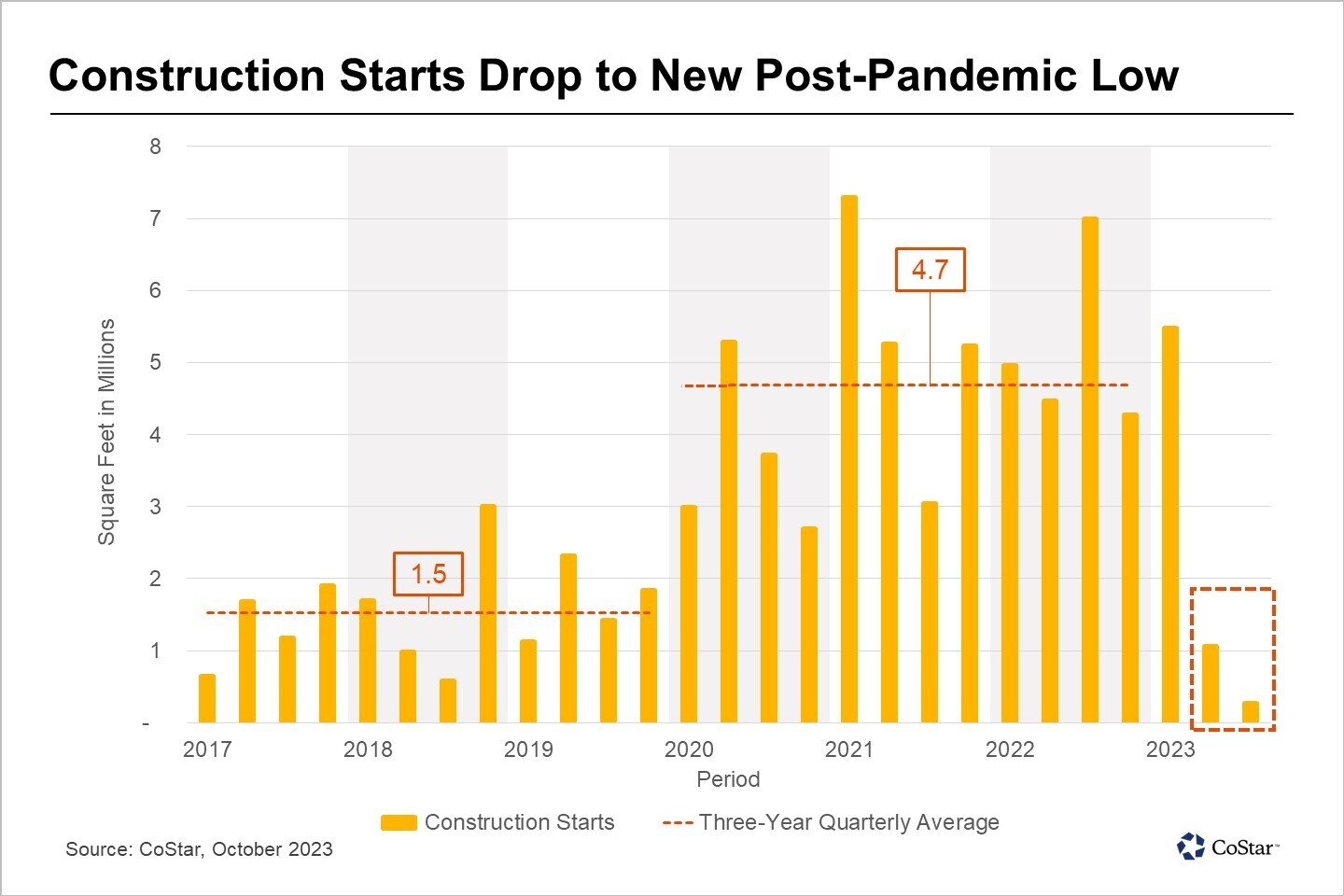
Reacting to a combination of higher borrowing and construction costs, as well as cooling demand for warehouse space, Philadelphia’s industrial landscape is showing the first signs of slowing development after three years of heightened construction levels.

During the past two quarters, the Philadelphia industrial sector averaged only 665,000 square feet in construction starts, a small fraction of the 4.7 million square feet of quarterly construction starts seen between 2020 and 2022. For context, quarterly construction starts between 2017 and 2019 averaged a modest 1.5 million square feet.

While the industrial sector has been a standout performer, demonstrating resilience even amid concerns over elevated interest rates and recessionary pressures, the recent near halt in construction starts and a pullback in leasing demand confirms developers are finally easing on their bullishness.

The effects of the area's recent construction surge are clearly visible in the region's availability rate, which jumped to 9.5% in late 2023, from 6.6% in mid-2022. Some sections of the region, including Burlington County in New Jersey, saw the average industrial availability rate surge as high as 16.5%. Recently completed projects have faced heightened competition in securing tenants, leading to a buildup of industrial inventory that has lingered on the market longer than originally anticipated.

These factors, coupled with a slowdown in leasing momentum, have prompted developers to reevaluate their strategies. Subsequently, construction completions are now outpacing deliveries, with projects under construction shrinking from 27 million square feet in the first quarter to 17 million square feet in the fourth quarter, a 35% decline.

The pullback in construction starts is expected to offer developers and owners some breathing room as they seek to lease still-vacant buildings, but another ramp-up of construction is likely should interest rates begin to decline and the economy remains resilient in 2024.

There are more than 220 industrial development projects encompassing some 65 million square feet that are already in the proposal stage across the Philadelphia region. And while not all of them will be approved, nearly 40% of the proposed industrial development is concentrated in Southern New Jersey.

Given the already elevated availability levels, developers are encouraged to exercise caution when considering new projects, as competition in the market remains fierce.

www.omegare.com

The worst is yet to come for commercial real estate: Incoming Oaktree co-CEO (Video)

www.omegare.com

Wednesday, October 18, 2023

Why some cities are likely to see taller warehouse projects — and the role Amazon is playing

By Ashley Fahey – Editor, The National Observer: Real Estate Edition, The Business Journals

After proliferating largely in other parts of the world, multistory warehouses are beginning to rise in the United States.

Nationally, there were 62.8 million square feet of warehouses with three or more stories in the U.S., as of August, with another 11.9 million square feet underway and 23 million in planning stages.

Notably, 74% of that pipeline and existing inventory is occupied by Amazon.com Inc. (Nasdaq: AMZN), the dominant player in industrial real estate, despite its pullback since the height of the Covid-19 pandemic.

But the cost to develop multistory warehouses continues to be higher than a more traditional industrial box, one reason why taller warehouses are likely to remain a fairly niche part of the market and concentrate in the nation's densest cities.

"We do think it’s going to continue to be a trend, and something we're going to see, and more are planned in many of these (denser) markets because there continues to be a need for occupier clients."

They recently examined multistory warehouses in the U.S., as the nation is in its fifth year of building multilevel logistics facilities. The first U.S. multistory warehouse opened in 2018 in Seattle.

Today, notable multistory warehouse projects include several in New York, where urban-logistics projects under construction and in planning would add 9.4 million square feet of additional last-mile logistics space.

Those include the 385,510-square-foot Red Hook Logistics Center in Brooklyn and the Borden Complex, which totals 680,000 square feet, in Long Island City.

The multistory warehouses being built in the U.S. today are past the point of "version 1.0" of five years ago, which tended to be larger projects, including some 1 million square feet or larger.

"People are looking at smaller parcels and then designing there, which is cool, because it gives occupier clients a little bit more variety," she continued.

At the Red Hook project, for example, there's an ability to subdivide the space by floor, so tenants that need 40,000 square feet or 80,000 square feet of industrial space in a dense urban market could lease space there, Lanne said.

Most of the urban multistory warehouse tenant demand is coming from groups needing last-mile delivery space, although, she said, there's also a lot of interest from food-and-beverage groups in occupying that kind of space.

Still, while the multistory warehouse trend has gained traction in the five years it's been in the United States, it's not likely to become a mainstream part of the industrial market.

For one, these facilities are more expensive to build — and may require specific, costlier infrastructure like underground parking, Lanne said. There are also zoning constraints to getting a multistory warehouse project approved, not unlike more traditional single-story industrial facilities.

Full story: https://tinyurl.com/yv5wxtrr

www.omegare.com 


How talent, funding and flexible workspace options are turning Philadelphia into one of America’s fastest-rising life sciences cities

 By Jeff DeVuono – executive vice president and regional managing director, Brandywine Realty Trust, The Business Journals

With a growing number of startups and established companies wanting a presence in Philly, the city has buzz. Here’s what’s behind it.

Over the last several years, no life sciences market in America has had greater momentum than Philadelphia. As the birthplace of cell and gene therapy, the city is not only producing breakout companies — including Spark Therapeutics (owned by Roche) and Tmunity Therapeutics (recently acquired by Kite) — it’s also become a place where both new and established cell and gene therapy companies are eager to have a presence. What’s more, Philadelphia has been at the forefront of other recent life sciences breakthroughs, including Nobel Prize-winning advances in mRNA technology that led directly to the development of Pfizer’s and Moderna’s COVID-19 vaccines.

With such success stories, it’s little wonder that the city has been rising rapidly in rankings of life sciences clusters. In recent reports, Philadelphia finished ahead of markets such as New York and the Research Triangle in the Raleigh-Durham area in North Carolina while closing the gap on longtime leader Boston in several key categories. For new and established life sciences companies, Philadelphia is now an essential part of the conversation.

Depth of talent in Philadelphia

What’s driving all this vitality? At the top of the list is talent. The work done by cell and gene therapy pioneers Carl June, co-founder of Tmunity, and Katherine High, co-founder of Spark and former president of therapeutics at AskBio, is attracting other highly regarded researchers and spurring even greater innovation. As of 2022, Philadelphia-based cell and gene therapy scientists had been granted more than 300 patents, and they were leading more than 130 clinical trials for new cell and gene therapies, according to research from the economics firm Econsult Solutions Inc. Overall, Philadelphia has one of the highest concentrations of life sciences researchers in the country, with its numbers rising nearly 20% between 2017 and 2022.

That injection of talent is bolstered by several other factors that are important to growing life sciences companies. The pharmaceutical industry — including such titans as Merck, Johnson & Johnson, and GSK — has long had a major presence in the Greater Philadelphia region, providing a deep talent pool of experienced leaders for startups and existing companies. The region is also strong at the other end of the career spectrum: new graduates. Greater Philadelphia is home to four R1 research universities, and its 93 colleges and universities have been producing an increasing number of people ready for careers in science. According to Colliers, the region now ranks ahead of San Francisco, San Diego and Raleigh-Durham when it comes to producing next-generation talent.

Philadelphia’s arrow is also pointing up when it comes to biomanufacturing capacity. At the forefront of the phenomenon is Spark, whose headquarters is located within Schuylkill Yards, the development created by Brandywine Realty Trust and Drexel University in University City. Spark’s groundbreaking gene therapy treatment, Luxturna — used for a rare form of genetic blindness — was approved by the FDA in 2017, and the company (which is developing gene therapy treatments for other diseases, including hemophilia A and B and several central nervous system disorders) is now building a 500,000-square-foot manufacturing facility in University City, adjacent to its headquarters. The decision by Spark’s owner, Roche, to place the new facility there, just a short walk from the University of Pennsylvania, Drexel, Children’s Hospital of Philadelphia and other leading research institutions, is further enriching the life sciences ecosystem in University City and cementing the neighborhood as one of the world’s leading gene and cell therapy hubs. Meanwhile, manufacturing capacity is expanding quickly throughout the entire Greater Philadelphia region, with additional facilities opening everywhere from the Philadelphia Navy Yard to King Prussia.

An influx of funding for life sciences

Not surprisingly, all the recent advances and activity in Philadelphia have caught the attention of funders. The most significant statistic: Since 2018, Philadelphia is the number-one market in the country when it comes to NIH funding for cell and gene therapy, outpacing Boston, New York, Seattle and Los Angeles. When it comes to NIH grants more broadly, Philadelphia pulled in more than a billion dollars in support from the NIH in 2022 for thousands of projects, including work from Penn researchers on the design of universal vaccines against highly mutating viruses, bacteria and cancer, as well as work at the Wistar Institute that explores immunotherapy approaches to early-stage melanoma. And the awards are going to a mix of institutions: the region’s 10 most awarded organizations have seen annual funding grow by 4.2% on average, while smaller, emerging institutions are seeing 12.3% annual growth.*

Thanks to that kind of validation, as well as the continuing breakthroughs being produced in the lab, private investors are also seeing the city’s extraordinary potential. In 2022, venture capitalists poured $1.7 billion into Philadelphia life sciences firms, a nearly 400% increase over 2020. And despite the cooling of the overall venture capital market in the second half of 2022 and first quarter of 2023, opportunities for young companies remain robust.

The inflow of money reflects the confidence both public and private funders feel in work originating in Philadelphia, and with good reason: Penn, whose groundbreaking research led to the development of mRNA technology, now receives more than $1 billion annually from mRNA licensing agreements.

Full story: https://tinyurl.com/5n86xpkc

www.omegare.com